The Studeblogger

Saturday, March 09, 2013

Advanced Distributing for Studebakers.

That little part above is, as you probably know, a vacuum advance canister (or "spark modifier" in Studebaker parlance" for a Delco distributor of the type used on Studebaker V8 Larks from 1960 to 1961. Although only used by the factory during those two years, the "window-type" Delco is prized by many Stude drivers because it's easy to rebuild, get parts for, and set point gap on, compared to the Prestolite units used on other years.

As detailed in an earlier post, I obtained and rebuilt one of these Delcos, using a core graciously given to me by Warren Webb, one of the regulars on the Studebaker Drivers Club Forum.

At the time I built it, however, I installed a vacuum advance specified for a 1961 Impala, figuring (wrongly) that a vacuum can is just a vacuum can. I should have known better! What I've found out since is that not all cans are equal. On this Forum thread, Joe Hall notes that the can commonly sold for Studebaker applications (NAPA VC680) is actually 2 degrees shy of the Studebaker OEM advance setting for V8 cars.

It turns out that nearly all of these vacuum advance units are all manufactured by Dana Engine Controls, now owned by Standard Motor Products, so no matter what brand you buy, it's the same part in the box. The trick is determining the right part. And there are about 25 different cans, each with a different setting for the point at which full advance kicks in. So how do you identify them?

Dana stamps a number on the mounting bracket of each advance unit. Each number corresponds to an advance profile that denotes how much vacuum must be applied to achieve full advance. It turns out, according to Joe Hall's research, that the Studebaker part number is "B20." The VC680 that NAPA's system specfies is "B1". Obviously the wrong part.

Insufficient advance can be responsible for lost power and poor gas mileage - both of which my Barney has exhibited. So I started digging to find out what part number was correct for the Studebaker distributor. VC1765 turns out to be the correct Stude part.

Thanks to the guys on the Corvette forums, who know their stuff when it comes to Delco parts, I found out the difference in the two parts' advance delivery settings:
  • VC680 (stamped "B1") delivers 0 degrees of advance until 8" of vacuum, and 16 degrees of advance at 16" of vacuum.
  • VC1765 (stamped "B20") deliver 0 degrees of advance until 6" of vacuum, and 16 of advance at 12" of vacuum.
So the part I had on the car started delivering advance too late, and full advance came in waaaaay too late. No wonder I was getting crappy mileage! B20, by the way, is the unit used on high-performance GM engines. I take a bit of pride in knowing that. (According to a very scholarly treatise on vacuum advances written by Lars Grimsrud of TunedbyLars.com, B26 carries the same specs as B20 and may be found in the same box.)

So I went to my friendly local NAPA and ordered a VC1765. Wisely, I  checked the part before leaving the store - the wrong part was in the box, with a hand-written label that had another part number on it! Always check. Another part ordered, and this time it was correct - B20 stamped into the boss.

Replacement is easy, and doesn't require removing the distributor from the car. Just unplug the coil wire and undo the two spring-loaded screw clamps that hold the distributor cap on, and move it out of the way. The screws that hold the vacuum advance to the distributor base are accessible from the passenger side of the car once the cap is removed.

As you can see in the photo above, there are two screws holding the advance unit on. Use a magnetized screwdriver to remove them, otherwise you'll be cussing as you remove the distributor to fish them out after you've dropped them! Also note that a lug attached to a wire that grounds the breaker plate is located under the screw at the end of the actuating rod - you'll need to replace it there after installing the new advance.

After the screws are removed, pull the advance unit out; the actuating rod will then be able to rotate out of the hole in the breaker plate by pulling the advance body upward.

Installation, as they say, is the reverse of removal. Once it's all back together, don't forget to check the timing and reset the idle if need be.

For some interesting reading about vacuum advance, check out this post from the Vetteclub Forum, and the aforementioned paper from Lars Grimsrud. You'll find out everything you need to know and more!

Labels: , , , ,

Tuesday, January 29, 2013

Avanti Eye Candy


There's nothing prettier than a really loving restoration. Brad Bez, who owns a shop called Bez Auto Alchemy in Washington state, has been blogging lately about an R4-powered Avanti upon which he's executing a painstaking body-off restoration for one of his clients. Check out his blog for the latest installment and follow along! I know it's inspiring for me... maybe you too? There's only one portion of Barney's frame that's as clean as the one shown here, and it's getting less shiny by the day ;)

Labels: , ,

Sunday, January 27, 2013

Installing a Studebaker Windshield


Up in Washington state, my friend Dick Steinkamp is restoring a very nice '63 Wagonaire. As part of the restoration, Dick needed to install a new windshield. There's an art to doing this, especially in an older vehicle like our Studes. Dick got an installer out to his place, and photo-logged the entire process. Check it out here.

Even if you don't plan on doing this yourself, this is a valuable lesson in how the job is done!

Labels: , ,

Thursday, January 24, 2013

Repro Studebaker C/K Fenders on the way!

One thing that owners of more popular marques - like Chevrolet, Pontiac, Ford, etc. - have long enjoyed is the ability to order reproduction sheet-metal for their cars. Heck, you can buy entire body tubs for '57 Chevys, but new body parts for Studebakers? Dream on.

(OK, sidebar: our friends at Classic Enterprises have a good assortment of structural steel pieces for our Studes - torque boxes, floor pans and such - but no body stampings.)

Anyway, Steven Tomblin of Goodmark (one of the aforementioned providers of GM and MoPar sheet metal) posted today on the SDC Forum that reproduction C/K rear fenders are just about ready to be released. Their prototypes are in the test-fit phase, in fact.

This is amazingly good news. While front fenders are probably needed more due to the rust-encouraging way that Studebaker designed them, the fact that a company - and a major one like Goodmark, no less - is beginning to reproduce Studebaker parts is a bright light indeed.

Maybe, with luck, we can look forward to new '59 - '61 Lark front fenders, or '64 - '66 trunk lids one day. I know, it's a pipe dream, but maybe...

Keep your fingers crossed!

Labels: , , , ,

Thursday, January 17, 2013

Studebaker Front End Rebuild Series

 
One of the most popular topics on my blog has to be the How-To series I wrote about rebuilding your Studebaker's front-end suspension. This is the topic of more questions than any other, and get more hits than any other here on the site, too. So here's a listing of all eight parts, now in one convenient carry-home size!

Now go get'er done!

Labels: , , , ,

Friday, September 28, 2012

The Scotsman Rides Again.

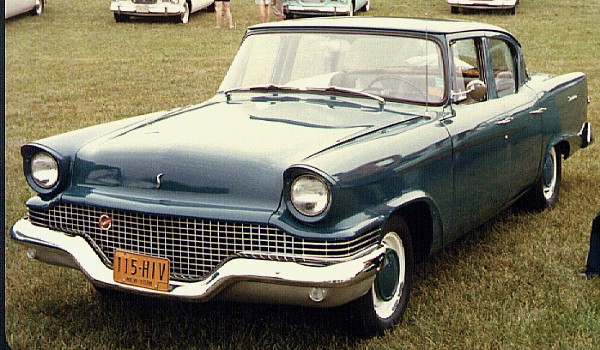
I was browsing Paul Niedermeyer's Curbside Classic site when I found a very well-written article on the Studebaker Scotsman, the low-priced base-price stripper that S-P fielded in 1957-1958 to try to gain a foothold with fleet sales and accounting firms. The Scotsman was the direct ancestor of my Standard, which was a return to familiar territory for the Corporation - take a regular offering and de-content it to meet a price point.


The Scotsman was beautiful in its own way - a big car devoid of chrome, ornamentation or fancy paint jobs in a go-go Atomo-Powered era that was all about glitz and flamboyance. Without the distractions, the smoothness and beauty of the car's lines were easily apparent. And the ploy worked, as Jeff Nelson describes in his article - enough Scotsman cars and trucks were sold to enable the Corporation to field the Lark for 1959, an even bigger success that would give the company another half-decade of life.

Read the article here.

Labels:

Friday, September 07, 2012

Fiberglas Hawk Panels!

We've all run across 'em - a car so beat, so decomposed, that even the thought of attempting metalwork on it gives you the cold sweats and causes your wallet to ball up in a paroxysm of self-preservation. But still, you want the car... you have a vision.

For those of you with a Studebaker Hawk in that viewport, there's some good news: you may find steel body panels scarce, especially for the later, lower-production GT models, but there's a company out there producing Fiberglas bolt-on fenders, doors and trunk lids for these rara avii. Meet Class Glass Performance, of Cumberland, Maryland.


These guys have been around since 1990, making Fiberglas parts for street and track racers. The Hawk's slippery profile has long been a favorite of drag racers, so 'glass body parts are a natural. They make everything from complete body tubs (shown above) to individual doors, trunk lids and front clips for '53-62 Studebaker C/K bodies. So when you find a car that looks like this:


...you can start thinking about bolt-on replacements instead of getting out the torch and spoon.They also make sweet fender replacements for Studebaker M- and R-series trucks!


Labels: , , ,

Wednesday, September 05, 2012

Studebaker Ad of the Week, #5: Lark takes flight!

A great example of Studebaker's early 60s' marketing. Here's a December, 1959 ad from Ebony magazine, showing people of color in an upscale setting, enjoying the beauty and power of their new Lark. I love the little touches, like the Lark logos as paragraph markers in the copy block, and the subtle lighting on the plane.

Labels: ,

Sunday, September 02, 2012

Happy Anniversary... to me!


I was just looking over my collection of Turning Wheels (the official monthly magazine of the Studebaker Drivers Club) and realized that it's been six years since I embarked on this crazy Studebaker adventure. It was August of 2006 when I purchased my 1963 Lark, Barney, drove him home, and signed up for the SDC. My first Turning Wheels issue was the August, 2006 edition.


Barney, as he looked in the driveway of the previous owner's home


Barney had lived a rough life, it turned out. He had a knock when I bought him; we knew it was the transmission flex plate that had cracked (I'd taken my friend John Dick, the gearhead, on the initial visit and diagnosed the knock - it went away under load, which ruled out rod bearings). What we didn't know was that the engiine's crankshaft thrust bearings were shot. Upon bringing Barney home, I took him to Brian Wilson, a neighbor who was a former transmission shop owner, who put him up on his lift (yes, a single-post lift in his home garage... so jealous) and showed me the quarter-inch endplay in the crank. Sure enough, when I drained the oil prior to pulling the engine, it was sparkly from all the ground-up brass in suspension.

There were other things. The transmission pan was caved in -- the 17-year-old girl who'd driven Barney previously had off-roaded him, embedding field grass in the frame and crushing the transmission's transfer tube, which burned up the rear pump. A motor mount was collapsed, and the engine was leaning over on the right A-arm. The suspension was shot: no rubber in the front at all, and flat leaf springs in the rear. The alignment was so poor that the car looked pigeon-toed.

And then there was the electrical system. It looked like a battlefield of demented spiders. Melted wires, the requisite bundle of bare-ended wires-to-nowhere hanging from the dash, and a lamp-cord horn circuit. In short, everything was a mess.

But the body was straight, and there was little rust. With a Studebaker, that's a huge plus.

Rebuilt 259 c.i. engine, 0.60 over, with viscous-drive fan, 4bbl. Carter WCFB
A Studebaker in its natural habitat -- on the road.
I Love my Lark!

Today, on the sixth anniversary of bringing Barney home, I can confidently say I'd do it all over again. In that time:
  • I've rebuilt the engine (well, had it rebuilt).
  • I've rebuilt the transmission (again, had it rebuilr. I sense a theme here).
  • I've rebuilt the suspension, front and rear (did that myself).
  • The brakes were converted from a single- to a dual-master-cylinder system, with all new hoses, shoes, drums and steel lines all around.
  • I completely re-wired the car with an OEM-spec wiring harness.
  • Cooling system and the Climatizer (heater) system were rebuilt as new.
  • Rebuilt the broken speedometer and installed an OEM electric clock.
  • Rebuilt the parking brake system, which was missing.
  • Installed a new dual exhaust system from the manifolds back.
  • Installed tons of other miscellaneous parts - windows, brightwork, fuel system, keylocks, and too much more to list.
Of course there's more to do... new paint, new interior, leaky windshield gaskets, rattle-y doors... but we'll get there. Along the way, I got involved with the Studebaker Drivers Club at the national level, and am now the Administrator for the club's online Forum, which is open to Club members and non-members alike (check it out here).

I love Barney and enjoy the heck out of driving him. I love the looks I get when I rip around corners in him, and the questions and thumbs-ups received, and the questions and conversations that ensue when people walk up and inquire about the car. I wish I'd gotten a Studebaker much earlier in my life -- but I'm sure glad I have him now!

If you're thinking about a Studebaker and wondering if it will be worth the effort - believe me, it will. You'll never meet a kinder bunch of folks than Stude folks. And you'll get more attention in a Studebaker than any Chevy, Ford or Dodge you might find.

Happy Anniversary, Barney. And here's to many more to come.

Wednesday, August 29, 2012

International Drive Your Studebaker Day is almost here!

Every year, the 2nd Saturday in September is designated International Drive Your Studebaker Day! That's the day for Stude owners to get their cars on the road and let them be seen. This year's date is September 8, 2012 -- so if you've got a Studebaker in the garage, get it out! Doesn't matter if it's not perfect -- just get it out and let folks see it. And bask in the glow of the thumbs-up you'll receive.

Labels:

Monday, August 27, 2012

Studebaker Ad of the Week, #4: Hawks Rock

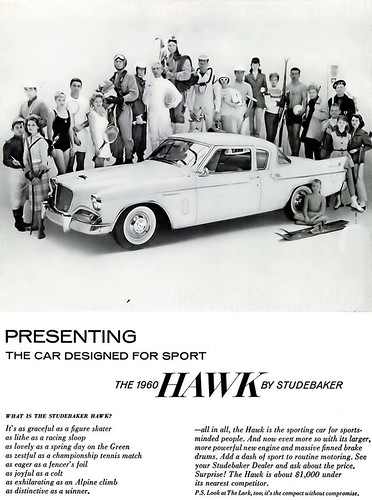
In 1960, the Hawk was in its 4th year as a model, but its 9th year as a body style. Where the original 1956 family of Hawks (Golden, Silver, Power, Flight and Sky) had been pitched as a complete range of sporty family cars with a range of powertrain choices and hardtop or sedan styling, by 1960 there was only one Hawk, and the Corporation was hitting the "personal car" concept pretty hard in advertising. Here's an example of that pitch, from the May, 1960 issue of Ebony magazine.

Labels: ,

Sunday, August 26, 2012

Steering Wheel Repair for the Home Studebaker Enthusiast

If you're working on an old car, you're likely at one time or another to come up against a steering wheel from hell. One that looks like the bad boy above (this particular vision in plastic was looted from from a '61 Studebaker Lark 4-door. The rest of the car looked worse).

So what do you do with a beast like this? Paint is easy enough, but what about the cracks? Several companies make kits to restore steering wheels (like this one from Eastwood), and some companies will re-cast your wheel -- they break off all the old plastic and mold new plastic onto the wire frame. Schrock Brothers are one such company well-known in the Studebaker world.

But most of us don't need a re-cast wheel and are willing to take on the process ourselves. But even though the kits you can buy are well-documented with detailed instructions, there's a bit of trepidation involved in breaking out the tools and cutting into your wheel, no matter how unlovely it is.

Tool Dude Tony, also known as Dudorino on the SDC Forum, has posted a YouTube video showing just how easy it is to do this job yourself; he illustrates on the wheel from his own '57 Hawk (seen in the vid). All you need are a few common tools, some two-part epoxy, and a little time, and you can have that wheel back in presentable shape in no time.


It's been noted in this Forum thread that the POR epoxy that Tony uses in the vid is suitable only for hard plastic wheels, as it cures rock-solid. If you have one of the flexible wheels, 3M #8081 Panel Adhesive is recommended as a filler, as it solidifies but does not harden.

Now there's no excuse for that lousy cracked wheel! Git 'er done!

Labels: , ,

Friday, August 24, 2012

Studebaker Ad of the Week, #3: Avanti!

1964 Studebaker Avanti  by coconv
1964 Studebaker Avanti , a photo by coconv on Flickr.
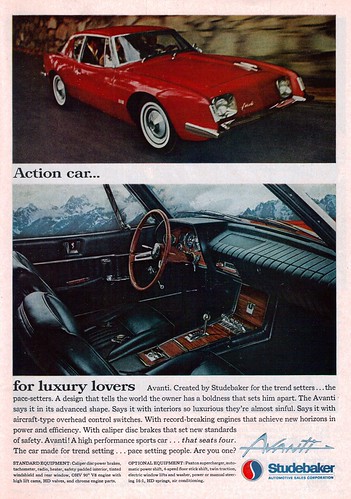
Love this ad for the '64 Avanti. As a good friend of mine says, "When this thing hit showrooms, it was like nothing anybody'd ever seen. It was a flying saucer."

Labels: ,

Tuesday, August 14, 2012

Adjusting Idle Mixture on the WCFB

Idle mixture is an important setting on a carburetor, and most people don't know how to do it. What you're trying to do is set your carburetor's idle circuits for the most efficient operation with the least fuel.

There's no better tool for doing this than a vacuum gauge. It can also tell you a lot about the health of your engine; it's really an invaluable tool. For a great walk-through of how to use a vacuum gauge for diagnostics, check out this tutorial from Greg's Engine & Machine, of Copley, Ohio.

But for setting the idle mixture, there's nothing like actually seeing it done. Here's a short video tutorial I put together, showing idle mixture adjustment using a vacuum gauge on my '63 Lark with 259 and WCFB 4bbl. As you'll see, it's simple and fast - all you need are a tach, vacuum gauge, wrench and screwdriver.


Now go get 'er done!

Labels: , , ,

Monday, August 13, 2012

Where can I find Studebaker parts?

Yeah, it's true - there hasn't been a Studebaker made since 1966. So it must be impossible to find parts, right? Wrong!

Check out this video taken at the recent (August, 2012) Studebaker Drivers Club International Meet in South Bend, Indiana. You'll see thousands of parts, mechanical, body and trim, plus interviews with parts vendors and reproducers who can find or make nearly anything for a postwar Stude.


If you're looking for Studebaker parts, as the video says,  your best bet is to join the Studebaker Drivers Club and avail yourself of all the resources available there. But if you're not the joining type, that's OK too - check out StudebakerVendors.com for a big listing of who and what.

Keep those Studes running!

Labels: , ,

Saturday, June 16, 2012

Light Up The Night.

Every so often someone posts to the SDC Forum asking about headlight aiming, so I thought I'd document some answers and useful links here.

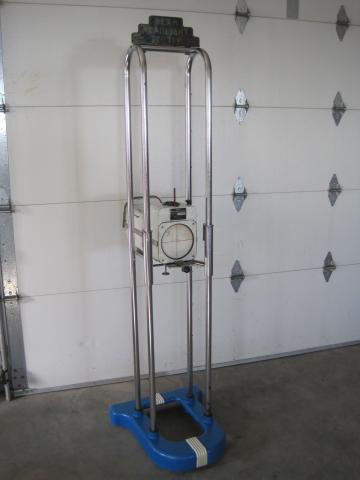
The high-tech, pay-someone-else-to-do-it method is to find a shop with a beamsetter. It used to be a lot easier to find these - remember the yellow Bear Headlight Alignment signs with the little laughing bear (that the Grateful Dead later copped) outside gas stations?

These items basically consisted of a unidirectional photocell that measured the candlepower of the light emitted by your headlamps. You pulled up square to the unit and adjusted the lamp until the focus of the beam produced the highest reading on the CP meter. (More about Bear Beamsetters here, if you're interested.)

Needless to say, these are rare birds in this day of sealed headlamp assemblies and halogen cartridge bulbs. So how do you aim an old Studebaker's lamps?

Daniel Stern in a guy who lives and breathes automotive lighting. His website has just about everything you'd want to know about bulbs, circuitry, output, regulations and more car lighting esoterica than you can shake a stick at. He has a wonderful, plain-language explanation of how to aim the bulbs on nearly any car - all you really need is a flat surface, about 40 feet of work space, a vertical wall and some painter's tape. Read it here: www.danielsternlighting.com/tech/aim/aim.html .

And while you're at it, maybe think about upgrading the headlamp circuitry on that old car. Another frequent question on the Forum is "Why do my headlights keep blinking on and off at night?" Generally, it's due to one of two things:
  1. That little booger on the left, there - a headlamp circuit breaker that's gotten old and weak, and is kicking off when the juice is applied, then back on as it cools down.
  2. The breaker is fine, but your wiring, switches and connections are old, and resistance in the headlamp circuit is so high that the breaker is doing its job, kicking off to prevent your wiring harness from turning into a mass of carbonized copper with melted plastic dripping off it.
Generally, it's a combination of the two. In old cars like ours, there is no headlamp relay - the juice to light you up goes straight through the headlamp switch in the dash, then back out to the front of the car. That's a long way for those electrons to travel, and there's loss along the way. (This is also, BTW, why your lights look dim and yellowish.)

The solution is to install a modern headlamp relay circuit. This takes the amps out of your dashboard and routes them directly from the generator/alternator to the bulbs, instead of taking the long way 'round through the Inland Empire (SoCal residents get the joke).

Daniel Stern also has a great article on how to do this, natch: read www.danielsternlighting.com/tech/relays/relays.html for the whole skinny.

Because there's nothing worse than being out for a nice cruise on a warm summer night... then having to feel your way home against the curb because your eyes suddenly went dark.

Labels: , , ,

Tuesday, April 24, 2012

Drivin' on the Coast.

Today, Barney took his longest drive yet away from home a 36-mile round-trip down coast to Solana Beach and back. It was a beautiful day, and we did some mixed driving - about half of the trip on the freeway, the rest along the 101 Highway. The drive was awesome - no problems of any kind, Barney easily kept up with freeway traffic (at one point hitting 75 to pass some tractor-trailer rigs) and just generally having a blast. He's in fine fettle and I'd feel no qualms about taking this car just about anywhere. Maybe La Palma on May 27th? Anyway, here's some pics from today's trip. Enjoy!

Today's route...
On I-5 heading South towards Leucadia
Along the Coast Highway in Cardiff-By-The-Sea
Coming back... looking north along 101 in Solana Beach. This is one of my favorite views along the coast.
North into Encinitas on the 101.
Spring wildflowers... just because I wanted to.

Labels: , ,

Thursday, March 08, 2012

Studebaker Ad of the Week, #2

1958 Studebaker Scotsman Series


Here's another great all-color 1958 Studebaker ad courtesy of Aldenjewell. Studebaker was no stranger to using low-cost cars to pull buyer interest, having done so successfully in the past with the wonderful 1939 Champion. In the recession year of 1957, they returned to the Champion strategy, de-contenting their full-size cars in order to lower the price fairly dramatically. They named these cars Scotsman, and they did reasonably well; well enough to reappear in the Studebaker lineup during the following model year as well.

Scotsman cars (and trucks) lacked such niceties as bright window trim, carpet, chrome front bumpers and even passenger sun visors and arm rests, although you could option-up these extras if you wanted. The '58s weren't as much of a sales success as the '57s were, but they kept scarce dollars coming into the Corporation long enough to fund the launch of the Lark in 1959 - the car that saved the company (temporarily, at least).

Studebaker would revive the Scotsman concept one last time, with 1963's Standard line and 1964's Challenger model. Some ideas just never go out of style.

Labels: , ,

Monday, February 27, 2012

Studebaker Ad of the Week, #1

1958 Studebaker Hawks Ad by aldenjewell
1958 Studebaker Hawks Ad, a photo by aldenjewell on Flickr.
Some eye candy for a rainy Monday, courtesy of Flickr automotive uber-poster Aldenjewell. This is really a rare piece, as times for Studebaker were tough - 1958 was such a lean year, that almost all print ads were black-and-white instead of 4-color. They didn't even print a full brochure that year - just color one-sheets for each model. So here's one of the very few full-color S-P ads for 1958 - enjoy!

Labels: , ,

Monday, February 20, 2012

Lark Deodorant: or, how to get rid of that fuel smell

If you own an old car, it's virtually guaranteed that you will spend time, effort and money trying to track down some problem that should be easy to fix, but which somehow eludes you in the same way in which common sense eludes politicians. This is the story of one such quest - now solved!

Almost since the first day I've owned Barney, there's been the smell of gasoline in the passenger compartment. I don't mean a little whiff - I mean "Hello sir, can I fill 'er up?"-level odor. It was bad enough to require driving with the windows open and vent wings, too, in order to keep the air clear. In chasing this problem, I'd been systematic - replacing the two soft sections of fuel line between the tank and carb, replacing every gasket, hose and tube between the filler neck and the tank inlet (see this post for details), and checking the seal for the fuel gauge sending level for leaks. Nothing worked... it smelled as strong as ever.

Finally, I got a break. I was browsing through Barney's Chassis Parts Manual last weekend (yeah, I read parts manuals for relaxation... ya wanna make something of it?), and noticed something I'd never seen before in the parts diagram for the '62-'63 fuel tank: a UFO (Unidentified Fixable Object).

Look at the diagram above. See the long, bendy tube coming off the filler neck and running to the left? That's the fuel tank vent tube. Studebaker used an non-venting gas cap on later Larks, so this tube was used as a fuel tank vent. It clips to the rear valence panel inside the trunk, wraps around the left taillight assembly, and finally exits through the trunk floor. Well, see the itty bitty part circled in red on the diagram? That's a grommet. It's purpose is to go on the end of the vent tube and seal its exit through the floor pan.

I had never, ever seen this part callout before! And of course, the original one was long gone, so there was no visual evidence that anything was supposed to be there when I inspected the trunk.

So I went down to my local Ace hardware and got an appropriate-sized grommet from the bins (1/4" I.D., 3/8" O.D.), slid it over the end of the vent tube and pressed it into place in the floor.


Woo hoo! That did the job. After a week, I went out and opened up the car at noon - typically when the smell was strongest, after having sat for a while in the sun. No smell! I drove the car around for about 2 hours that afternoon, just to make sure, and the problem is gone.

So, big thanks to a .45-cent part for making my car pleasant to drive again :)

While I was at it, I fixed one more fuel-related problem. A few weeks back, I moved the car onto the street and parked it nose-up (I live on a pretty steep hill). When I came back, a wet spot under the back bumper and a slow, steady drip told the tale: the fuel cap seal was about as loose as a sailor on Friday night.

The factory fuel cap uses a partial-face seal. In the photo at right, you can see it just around the center stamping - that dark brown circle. This is a fiber gasket attached to a steel backing ring; it's only as big as the end of the fuel filler itself and seals to the rolled edge of the filler pipe. I guess that after 49 years, this seal has gotten a bit softer than it was, originally.

The fix for this is actually pretty easy: just add more gasket material. I went down to my neighborhood NAPA and got a roll of 3/32 Fel-Pro cork gasket material. I used aluminum foil to trace the size the gasket needed to be, then cut a circle out of the cork and slipped it around the center of the cap.


Now the cap fits nice and snug, and there's no way any gas is getting past that seal. It ought to help with my fuel economy, too, since the gas formerly used to lubricate the asphalt will now be going into the carb!

Labels: , ,

Saturday, February 11, 2012

Wiper Arm Replacement

It's been crunch time at work, and I've been writing so much that the last thing I want to do when I'm done for the day is write some more... so the blog has been suffering. I'm sorry about that, and thanks to all of you who have written asking if everything was OK. It is! Just very, very busy.

I'm going to walk through something that seems pretty simple, but is actually an operation most folks have no idea how to do: replace a windshield wiper arm. I'm not talking about the blade - I mean the actual chrome/stainless arm that moves back and forth across the glass.

The passenger's side wiper on Barney has been worthless since day one; it simply didn't have enough spring pressure left to hold the arm tight against the glass and force the rubber to wipe. So the edges of the wiper would contact, and the middle would stay unwiped.

Someone had obviously monkeyed with the wiper before. On Trico wiper arms, which Studebaker used for Larks, there was a little stainless-steel cover that protects the spring. On this arm, that cover was sprung and the spring had been replaced, to no avail.

You can buy Avanti wiper arms all day long - they've been reproduced. Not so much for Larks. One of the Avanti arms works on the Larks; it's the driver's side arm ;) There are "universal fit" arms available, but these are mickey-mouse contraptions with adjustable joints and such to try and get the blade angle right... no thanks.

I finally found a dude parting out a '63 Cruiser on eBay and scored a pair of arms for $20, so yay! I could finally replace the old passenger-side arm with one that worked. The new arms arrived and they were sweet, so today was the day.

Here's the part that gets tricky: removing the old arms. No one really knows how to do this! It's one of those things you really never have to do... until you have to do it. The arms press-fit onto a splined hub that's driven by the wiper motor and transmission, but it's not the press-fit that holds them on: it's a small spring clip built into the arm itself, which engages the bottom of the driven hub and keeps the arm from flying off when it's being used. This photo shows the clip.

So the question is: how do you get under there to disengage that clip? Ah, well, like everything else, there's a tool for that.

Lisle #65750 is a windshield wiper removal tool. If you look at it, you can see that there's a tab with a little tang on the end; you insert this tang under the end of the spring clip on the wiper arm and pull while you (or a helper) leverage the arm off of the hub.

Problem is: nobody, and I mean nobody, carries these tools. They're not expensive, but if you want one, you're going to have to get it from JC Whitney or some other mail-order house. And, if that's what you want to do, you can stop reading right here, because we are not going to use this tool to remove the wiper arm.

Instead, we're going to use this tool, and a small pry bar. It's yer standard Craftsman right-angle awl, and it will do the job just fine with a bit of finesse.

First, protect your paint. Put a couple of rags or pieces of cardboard on either side of the wiper hub, and make sure that you're not pressing on the paint as you use the tools. Also make a mental note of approximately where the end of the wiper arm is laying against the windshield, so that you get the new arm on in the correct position.

Oh, and you'll need to remove the wiper blade from the arm before you begin. On these older-style arms, it's really simple: just find the little spring clip underneath the junction of the arm and blade. Pull it down, away from the arm, and slide the blade off.

This is actually easier with a helper, but you can do it yourself - I did! Lift the arm and locate the spring clip. Slip the point of the awl behind the clip and pull away from the wiper hub. While keeping that outward pressure, use the small pry bar to lift the opposite side of the wiper arm at the hub, as the photo shows.

Don't use a whole lot of pressure - you don't need to. If you've released the clip, a small amount of upward pressure on the opposite side will slide the arm easily off of the hub.

Remember when I said someone had monkeyed with this arm before? Here's the proof. The splined hubs are pot metal, and someone had boogered this one, probably by being ham-handed with a tool to get the arm clip to release. They must have really wailed on it to have taken a chunk this large out; luckily, there's still enough area there for the clip to engage and hold the arm onto the hub. If this hub had been damaged more, I'd have had to hunt down a new pivot assembly - the hubs are not separable from their shafts.

So now, it's just a matter of sliding the new arm onto the hub. Do a test-fit - position the arm to match the position of the old arm (you made a mental note, right?) and slide it on partway to check its angle. If it's not right, pull the arm back off and reposition - you might need the assistance of the pry bar again. If it's good, push the arm all the way on and give it a sharp smack with the heel of your hand - you'll hear and feel the spring clip engage. Woot! 

All done, right? Not so fast, Ace. As long as we're working on wipers, there's one more thing that's usually overlooked: lubricating the wiper transmission. There are a series of connecting rods hidden inside the firewall vent cavity that convert the rotary motion of the wiper motor to the reciprocating motion of the wipers, and there are three connecting points that need to be oiled up. If you've ever driven an old car whose wipers squeaked when you turned them on, it generally because no one has lubricated them in a very long time - if ever! 

On my Lark, you access the wiper transmission through the cowl fresh-air vent. Open the hood and you'll find four Philips-head screws that hold the vent grille to the cowl. remove them and the grille slides right off.
With the grille off, you'll have easy access to the transmission rods. The photo on the left is looking into the cavity from the driver's side of the car; you can easily find two of the three lubrication points. The photo on the left is a view from the passenger's side of the car, and shows the third, hard-to-get-to point, which is hidden under the driver's side of the cowl. You will need a telescopic oiler to reach this point. It might help to run the wipers a bit and shut off the key in the middle of the cycle, which will position the lubrication points more near the opening in the cowl.
Drench 'em with your favorite lube - I keep a little bottle of Marvel lubricating oil around for this, but you can use engine oil too if you like. Put the grille back on and you're good to go!

Labels: , , , ,